I read a lot of interesting books this month. They ran the gamut from my usual preponderance of mysteries to an older novel, a book by a vegan runner, MOBY DICK (!!), and two memoirs of sorts.
The Light Years - Elizabeth Jane Howard
Eat and Run - Scott Jurek
The Sound of a Wild Snail Eating - Elisabeth Tova Bailey
Lament for a Lady Laird - Margot Arnold
MOBY DICK (I'm sorry, I'm just so proud I read it!) - Herman Melville
Murder in Stained Glass - Margaret Armstrong
A Cat of a Different Color - Lydia Adamson
A Great Reckoning - Louise Penny
In the Company of Dolphins - Shaw
The Blue Santo Murder Mystery - Margaret Armstrong
Something Borrowed, Someone Dead - M. C. Beaton
Widowmaker - Paul Doiron
Thursday, September 29, 2016

Widowmaker - Paul Doiron

I read five books in the five days we were in Maine (2 days out of the week were travel days), but I've only read one in the three and a half days since we got back to Philly. Mostly, I've been doing laundry, buying groceries, and going through a week's worth of mail and newspapers (for the crosswords). Yesterday, Jack and I walked up to the library to pick up Widowmaker, which they were holding for me. I read it in two days (technically, a day, since I started it yesterday afternoon, didn't read it last night or this morning, and finished it this afternoon).
This is a series that Elaine, of Random Jottings, in Colchester, England, posted about a few years ago. Here he was, in my own backyard, but I had never heard of him. Him being Paul Doiron, him being Mike Bowditch, Maine game warden. Now I've read all seven of these books.
Mike Bowditch is a game warden who has trouble following the rules. He's had many close calls and they've left him with both physical and emotional scars. He's only 29 in this book.
Widowmaker is a ski resort on its last legs after a fatal accident involving poor maintenance of a ski lift. A woman who works there finds Mike and tells him she wants him to find her missing son - who she says is Mike's half brother. It could be true because Mike's father was a womanizer and a poacher and a general bad guy. Mike balks at first and then decides he has to find out the truth.
Along the way, he encounters a couple of druggies and confiscates their wolf dog. It's illegal to own a wolf dog in Maine unless you have a permit. There's something about this wolf dog - his superior intelligence, his acceptance of people, his wildness - that gets to Mike. The dog will be euthanized unless Mike finds someone qualified who will take him. He finds a wolf rescue in New Hampshire, but, after visiting it, Mike can't leave him there. The dog is domesticated but has killed a deer, so he's considered dangerous. DNA shows that he's 90% wolf.
The boy who may be Mike's half brother is a convicted sex offender. When he was 18, he had sex with his underage girlfriend. Her father found out and convinced / coerced his daughter into saying it wasn't consensual. Now the boy's branded a sex offender, on the sex offender list, but without a description of his crime. He's been sent to a logging company that is the last resort for sex offenders who can't find work anywhere because of their conviction. In reality, it's a slave labor camp.
Mike can't find the missing boy, but his bloody truck is found. Someone decides to become a vigilante and rid the world of sex offenders and perverts, which is whomever fits their own description of pervert. Was Mike's brother one of his victims?
The last several pages flew past as I raced to the end. Which was slightly disappointing. I like books with all the loose ends tied up tightly and this one didn't do that. Just a personal preference. But, it was a fun read and very exciting in parts. Snowstorms, wolf dogs, cross dressers, helicopter crashes - what more do you want?
Wednesday, September 28, 2016
Cape Elizabeth, Maine

Isn't this pretty? Wouldn't you want to spend a few days looking at lighthouses and fog and crashing waves and sea birds? Well, we would and we did.


We rented the most charming cottage in Cape Elizabeth, ME, for a week to escape the heat, humidity, dirt, and noise of Philadelphia. The owner, an artist and gardener, met us and showed us around. Her talents are obvious at the cottage. The cottage has been completely updated and decorated in a casual, chintzy, antiquey style. It has new bathrooms (1.5), a new kitchen, and everything you might need or want to be comfortable.
The cottage is surrounded by gardens, with hydrangeas, ferns, turtlehead (a native favorite of mine and the bright pink flower above), touch-me-nots, and other plants. Our last morning there, we saw a deer up to her neck in ferns, just her long ears and dark eyes showing. We watched the squirrels, chipmunks, and little red squirrels. I will, however, never talk to you again if you rent the cottage when we want to rent it - which is all the time!
The road is private, so there's little traffic. It's very dark and very quiet at night. The cottage is less than 500' from a private cove. The cottage isn't oceanside, but you can see the ocean from the cottage. In the morning, I would lie in bed and watch the sun come up over the sea. At night, the sound of waves lulled us to sleep. I tried to buy the cottage, but she wouldn't sell! I don't blame her. It's paradise.

We walked to the cove every day and sometimes twice a day. Maine beaches are usually pebbly, as this one is. You could swim - if you dare to brave the frigid Maine water. (And if you can swim, which I cannot.) The ocean is endlessly fascinating. There are birds and boats to watch. The sea changes every few minutes. At the beginning of the week, there was fog, which meant fog horns, and which made me want to watch the old TV series Dark Shadows.
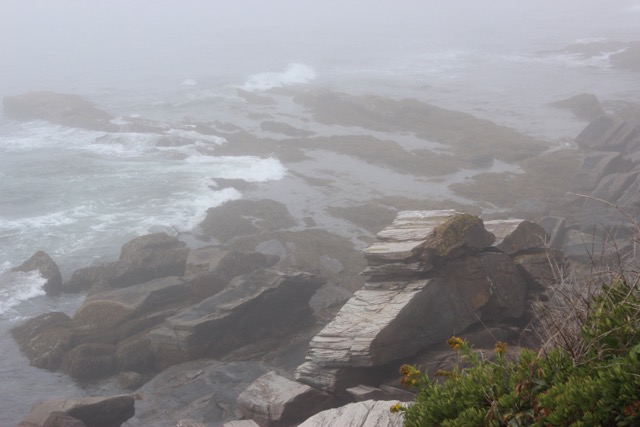
At this part of the coast, the rocks look like petrified trees. I was sure they were, but I found out they are 400-million-year-old silt formations. They still look like petrified trees to me.


Winslow Homer and Edward Hopper both painted here. Edward Hopper painted Two Lights Lighthouse, which is the one in the top photo. The coast abounds with lighthouses, and shipwrecks. Portland Head Light is a short drive away. You can go to Crescent Beach State Park, Two Lights State Park, or Fort Williams Park, all less than twenty minutes away. Two Lights was our favorite and the closest. This is Portland Head Light, which Hopper also painted.

Portland is less than a half hour drive and has restaurants, bars, shops, and is a nice old town down by the water. We always stop at Gritty McDuff's because an old friend of mine used to bartend there. Back in 1989, we were bartenders in Boston, and then she moved to Portland. Cape Elizabeth has at least two good restaurants, too. We were impressed and pleased by the two we ate at: The Good Table and Rudy's. C Salt Gourmet Market makes great sandwiches
There was also time to read. I read five books while we were there. I've posted about a couple of them. We sat on the open patio in the afternoons and read. Jack read his vacation book. I cannot understand people who only read on vacation - and yet I'm married to one. On the other hand, he probably can't understand why I can't keep my nose out of several books at one time.
Here are some random photos of the fog and the rocks. Most of the days we were there, the sun was shining, but I, being photophobic, prefer the foggy days. I already miss everything about Cape Elizabeth, Maine, and can't wait to go back.




Friday, September 23, 2016
The Blue Santo Murder Mystery - Margaret Armstrong

I just read and reviewed another book by Margaret Armstrong, Murder in Stained Glass. I bought The Blue Santo Murder Mystery at the same time, and I've just bought the last of her three mysteries, The Man With No Face. These are all Kindle books at about $3.99 each. A very good deal, I think.
This book starts a bit backwards, with the news that the richest woman in America, Mrs. Kearny-Pine has disappeared while vacationing in New Mexico. The news is shocking. Then the book moves to Tecos, New Mexico, before Mrs. Kearny-Pine disappears.
The Blue Santo is a hotel, as well as the name of a carved figure over the hotel's mantelpiece. The local Indians / Native Americans consider it bad luck. Mrs. Kearny-Pine wants to buy it. Very badly.
She's not an easy woman to live with, as her younger, philandering husband knows, or to deal with, as her high-living nephew, Algy, or her very nice young cousin, Rosalie, know. Or as many other people know. She wants what she wants and she gets what she wants.
But when she disappears from the hotel, everyone is out looking for her. It's a real puzzle. She's just vanished. Everyone has a theory.
Despite some stereotyping of Indians / Native Americans (this was published in 1941), I think the author did a good job with her characters and with describing the landscape, although I have to admit I've never been to New Mexico. If I'm wrong, tell me. The plot was good, too, ending with a twist just when I thought I knew everything.
I'm eager to read The Man With No Face. There don't seem to be any consistent characters in the three books. I was sorry that Miss Trumbull from Murder in Stained Glass didn't reappear.
While I was trying to find out how many mysteries Margaret Armstrong had written, I found that I probably have some of her books: she was a highly sought-after designer of book covers and book bindings. Before I stopped collecting things, I collected what I call illustrated bindings, those gorgeously decorated books that it would be a shame to cover with dust jackets. Most of her covers were Art Nouveau, a style I particularly like. Some of her art is in the Metropolitan Museum of Art in New York City and she wrote and illustrated the first book on wildflowers of the American West. A very interesting woman indeed.
Thursday, September 22, 2016
A Great Reckoning - Louise Penny

I've read all of Louise Penny's books and she never disappoints.
Armand Gamache is now the head of the Surete Academy (there should be some accents over 'Surete' but if my lap top has them, I don't know where they are), determined to reform the way police cadets are chosen and trained. It's a difficult job because there's been so much corruption. He fires many of the professors and replaces them with people he knows to have integrity. But some of his choices are questioned because they are those very corrupt people. Gamache has his reasons.
He is also personally checking the applications to the academy, accepting most of the previously reviewed acceptances and rejections. But when he comes to Amelia Choquet's rejected application, he reverses the decision and admits her. She seems unsuited for the position: pierced, tattooed, a rude street girl, who reads ancient Greek and Latin, or so she says. Why does he seem to have a special relationship with her? He's questioned about admitting her, but he has his reasons.
An instructor at the academy is murdered. Gamache, Amelia, and several others are suspected. As the case is investigated, dark secrets are revealed. Gamache asks that a high official in the Royal Canadian Mounted Police review the investigation as an outsider since the investigation is being conducted by Isabelle Lacoste, a former member of Gamache's homicide squad and now head of that squad.
Meanwhile, in Three Pines (where we all want to live), an old map has been found in the walls of the bistro. It's of Three Pines, which has never shown up on any map before. Not even now. Gamache asks four cadets to investigate the map and find out all they can about it. A couple of the cadets think it's busy work, a waste of time for a police officer in training. Gamache has his reasons.
It all comes together in the end, the stories, the people, the crimes and their solutions.
And we find ourselves back in the warm circle of friends in Three Pines.
Louise Penny has written a touching Acknowledgements at the end of the book, allowing us into her personal life. My heart goes out to her.
P.S. As I post this, I see that there is an update to her Acknowledgements.
Thursday, September 15, 2016
Murder in Stained Glass - Margaret Armstrong

This is one of the reissued Queens of Crime mysteries. Margaret Armstrong is new to me. I read it on my Kindle. While I was doing that, I was wondering when it was written. You know how it is: on a Kindle, it's not easy to flip to the front or around in the book. Anyway, it was published in 1939. It sometimes feels more modern than that.
The narrator, a Miss Trumbull, goes to stay with an old school friend, Charlotte Blair, in the village of Bassett's Bridge, Connecticut. She says she doesn't "enjoy visiting - most spinsters like their own homes better than other people's". I'm not a spinster, but I like my home better, too. Charlotte has always been a bit strange and she seems to have become stranger, birdwatching at night and having odd spells, when she stays in her room for days. The villagers think she's bizarre. But her young cousin, Phyllis, who is staying with her, is charming and lively.
Anyway, Miss Trumbull, after making all sorts of excuses, goes to Bassett's Bridge and gets wrapped up in a murder. A famous stained glass artist, Fredrick Ullathorne, works in the village. He's currently working on a window for a New York City cathedral. They all go to take a look. And then he disappears, and bones and a false tooth of his are found in the ashes of the kiln in his studio.
Miss Trumbull needs to know what happened, especially when suspicion falls on Charlotte and on Phyllis's fiance, Leo, the artist's son. She figures it out and is almost murdered herself. There's quite a twist at the end.
I liked Miss Trumbull and I liked the description of the life she and her friends led, going to plays and the opera and teas in the city. I believe there is one mystery that didn't get solved, but, on the whole, this is a satisfying and nice mystery.
Moby Dick - Herman Melville

I was beginning to wonder if I would ever write this post. I started to read Moby Dick last summer. Actually, at the suggestion of a couple of fellow bloggers, I simultaneously read and listened to it, using the Moby Dick Big Read site. That was helpful. When my mind started to wander, the reader's voice brought me back. Most of the time.
Moby Dick could have been two good books: one, the exciting adventure of Ahab, the captain of a whaling ship, obsessed with revenge on Moby Dick, the unusually vicious white whale that caused him to lose his leg; the other, a fascinating and detailed look at the anatomy of whales and the intricacies of whaling - for those interested.
Interspersed between the chasing and killing of whales (which was hard for me to read, especially since we now know how intelligent and social whales are), are chapters that are deadly dull. Do you think that Melville used this technique to reflect the voyage of a whaling ship? They went to sea for three years at a time, seldom making land, floating around for days or weeks waiting to encounter whales. Dull, dull, dull, excitement!
Moby Dick is so well known, but is it widely read? I think it's a difficult book, because of the boring parts, so I suspect that even though many people know the story, they haven't read the book. Truthfully, I didn't know what the ending was. I'm sure I've seen the movie, starring Gregory Peck, but even so, I didn't know who won. I was disappointed with the ending. The last three chapters are exciting, but I wanted a more dramatic ending. I wanted Moby to swim off while chomping on Ahab.
I made some notes while I was reading, but I'm not sure you want to read them all. "..sin that pays its way can travel freely, and without a passport; whereas Virtue, if a pauper, is stopped at all frontiers", "since Christian kindness has proved but hollow courtesy", "... a man's religion is one thing, and this practical world quite another". He laments the killing of old, blind whales to light the lamps of churches that preach compassion. He and I both have a problem with churches and hypocrisy.
Melville encourages conserving the use of whale oil lamps, fearing for the lives of whales because people don't make the connection between lamps and whales. (Like people often don't make the connection between lamb chops and the slaughter of baby sheep.) In Chapter 65, he made me wonder if he was a vegetarian because he castigated those who eat animals, wondering why 'civilized' society reviles cannibals when they're no better, and even mentions (the) 'enlightened gourmand, who nailest geese to the ground and feastest on their bloated livers in thy pate-de-fois-gras." Hmmm. Just sayin'.
There is some nice writing, sometimes bordering on the Dylan Thomas-esque, but a lot bordering on religious wailing ("Then hail, for ever hail, O sea, in whose eternal tossings the wild fowl finds his only rest", etc.). Surprisingly, there were parts what were pretty funny. I giggled when the sailors reefed their jackets into the sails and had to hang there until they sorted it out. I admit that there were many times when I had no idea what he was trying to say. There are probably books interpreting Moby Dick, but I'm done. I got out of it what I wanted to get out of it.
(For Katrina, Ishmael was a Presbyterian.)
Ah, well, it's over at last. I think I should celebrate.
Subscribe to:
Posts (Atom)